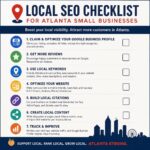

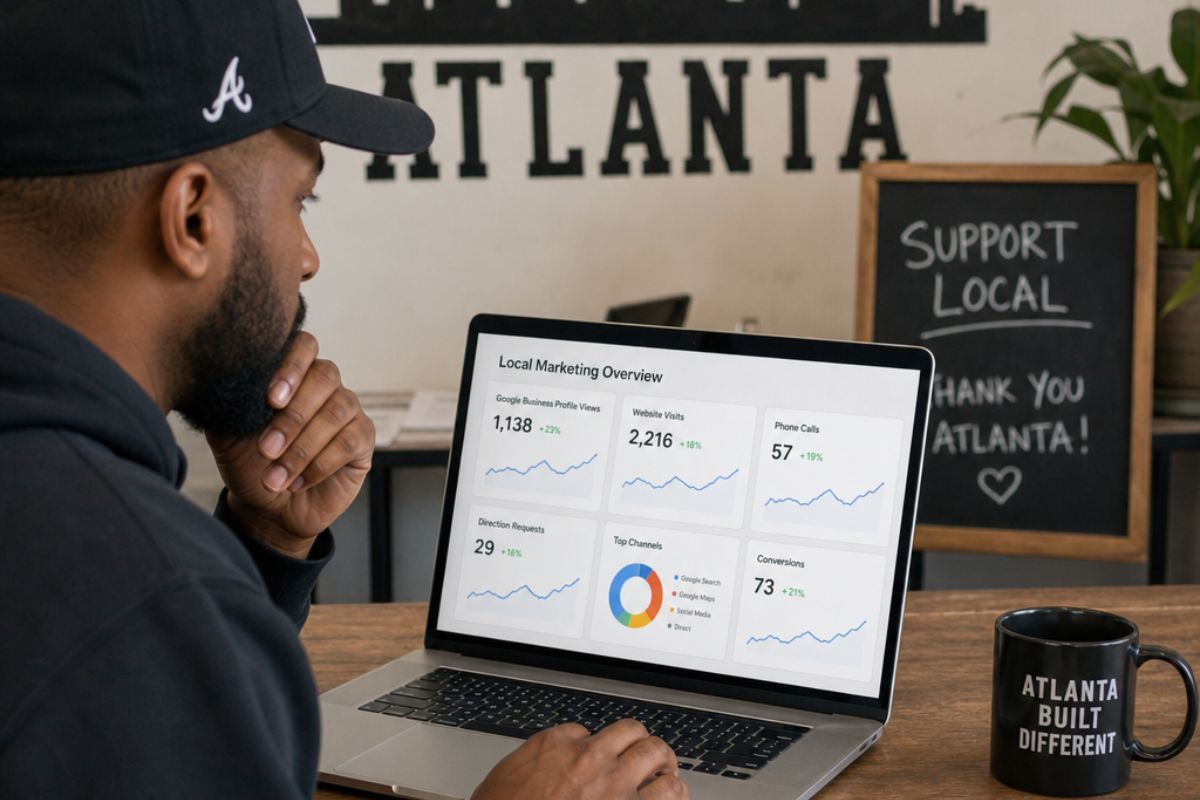

Atlanta is a competitive market, but small businesses don’t need national-brand budgets to win online attention. With the right mix of local SEO, paid ads, social media, content, and reputation building, digital marketing for small business in Atlanta can turn neighborhood visibility into steady leads, calls, visits, and sales. The key is to focus on where your best customers already search, scroll, compare, and make decisions.
Table of Contents
How can Atlanta small businesses compete with bigger brands online?
Small businesses in Atlanta can compete by going narrower, faster, and more local than larger competitors. Instead of trying to rank for every broad keyword or advertise across the entire metro area, focus your online marketing Atlanta strategy on specific neighborhoods, services, customer problems, and buying moments. A restaurant in Grant Park, a contractor in Decatur, or a boutique in Buckhead can often earn better results by becoming the most relevant local answer rather than the loudest brand in the market.
That means your marketing should reflect how people actually choose local businesses. They search “near me,” compare reviews, check photos, browse social media, look for proof, and expect your website to load quickly and answer basic questions. If your business shows up clearly at each of those moments, you gain trust before a customer ever calls.
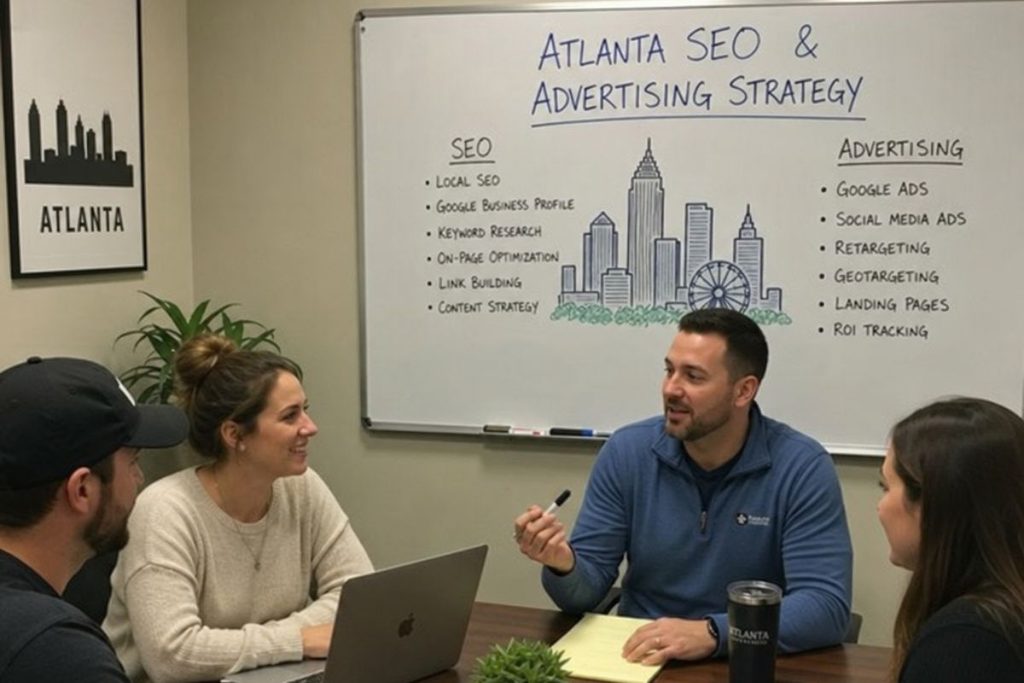
A practical Atlanta digital marketing plan usually includes:
- Local search visibility: Google Business Profile optimization, local landing pages, map rankings, and consistent business listings.
- Conversion-focused website content: Pages that explain services, service areas, pricing factors, process, and next steps.
- Paid advertising: Google Ads, Meta ads, retargeting, and local campaigns aimed at high-intent audiences.
- Social proof: Reviews, testimonials, case examples, project photos, and community involvement.
- Consistent content: Blog posts, FAQs, short videos, email updates, and helpful resources that answer customer questions.
- Measurement: Call tracking, form tracking, analytics, and lead-quality reviews so you know what is working.
The advantage for small businesses is agility. You can update a service page, respond to a local trend, publish a neighborhood-specific offer, or adjust an ad campaign much faster than a large company with layers of approval.
Local visibility starts with search intent
Strong small business seo begins with understanding what your customers mean when they search. Someone typing “emergency plumber near Midtown Atlanta” is not casually researching; they likely need help now. Someone searching “best family photographer in Decatur” may be comparing portfolios, prices, and reviews. Your website and local listings should match these different levels of intent.
For many Atlanta businesses, the highest-value searches include a service plus a location. Examples include “roof repair in Buckhead,” “wedding planner Atlanta,” “Sandy Springs med spa,” or “coffee shop near Piedmont Park.” These searches are valuable because they show both interest and local relevance.
Your website should make those connections easy for search engines and customers. A single homepage rarely gives enough detail for every service or neighborhood you serve. Dedicated pages can explain what you do, who you help, where you work, and what makes your business a good fit.
Build a stronger Google Business Profile
Your Google Business Profile is often the first impression customers get. It may appear before your website, especially on mobile searches and map results. Treat it like a living storefront rather than a one-time listing.
Keep your name, address, phone number, hours, categories, services, photos, and website link accurate. Add recent images that reflect your real business, not generic stock visuals. Post updates when you have seasonal services, events, new offerings, or helpful announcements.
Reviews matter here, too. A steady review strategy can support local marketing Atlanta efforts because people want proof from nearby customers. Ask satisfied customers for honest feedback, respond professionally, and use recurring comments to understand what people value most about your service.
Create neighborhood-focused pages with real usefulness
Neighborhood landing pages can help, but only when they are meaningful. A weak page that simply swaps “Atlanta” for “Midtown” or “Buckhead” will not build much trust. A useful page explains the service, includes relevant local context, answers common questions, and gives customers a reason to contact you.
For example, a home services company might create pages for Midtown, Decatur, and Sandy Springs that mention service availability, common property types, scheduling expectations, and examples of problems customers in those areas often face. A local fitness studio might build pages around nearby neighborhoods, parking, class types, and beginner-friendly options.
The goal is not to create dozens of thin pages. The goal is to give each important audience a page that feels written for them.
A balanced channel mix reduces wasted spend
Small business marketing works best when each channel has a clear job. SEO builds long-term visibility. Paid ads create faster traffic and lead flow. Social media keeps your brand familiar. Email nurtures people who are not ready to buy today. Reviews and referrals make every other channel more persuasive.
When businesses struggle with digital marketing Atlanta campaigns, it is often because they expect one channel to do everything. A boosted social post may create awareness, but it may not capture urgent search demand. SEO can produce strong long-term returns, but it usually takes consistency. Google Ads can drive leads quickly, but campaigns need targeting, budget control, and conversion tracking.
A simple way to think about your mix is:
| Channel | Best use | Practical small business goal |
|---|---|---|
| Local SEO | Capturing people searching nearby | More calls, visits, and map visibility |
| Google Ads | Reaching high-intent buyers quickly | Leads for priority services |
| Meta ads | Building awareness and retargeting | More website visits, bookings, or inquiries |
| Social media | Staying visible and human | Community engagement and trust |
| Email marketing | Nurturing existing contacts | Repeat business and promotions |
| Content marketing | Answering questions and building authority | Organic traffic and better conversions |
This does not mean you need to do everything at once. It means you should understand the role each channel plays before spending money. A new business may start with local SEO basics, a small ad campaign, and active review generation. A more established business may add content marketing, retargeting, email automation, and more detailed reporting.
Paid advertising works when it stays local and specific
Digital advertising Atlanta campaigns can be effective for small businesses when they avoid broad, unfocused targeting. Atlanta is large and diverse, with different customer behaviors across neighborhoods and suburbs. Your ads should reflect that reality.
Google Ads can help when people already know what they need. Search campaigns are often useful for service businesses because they target demand that already exists. If someone searches for a specific repair, consultation, appointment, or local provider, a well-written ad can bring them to a page that matches that need.
Meta platforms such as Facebook and Instagram can support awareness, promotions, event marketing, and retargeting. They are especially useful when visuals, community connection, or repeat exposure influence buying decisions. A local restaurant, boutique, gym, salon, or event venue may benefit from campaigns that highlight atmosphere, offers, customer experiences, and location.
Make every ad click land somewhere relevant
One common mistake is sending all ad traffic to the homepage. If your ad promotes a specific service, offer, or location, the landing page should continue that conversation. A person who clicks an ad for “AC repair in Atlanta” should not have to dig through a general website to find AC repair information.
A good landing page includes:
- A clear headline that matches the ad promise.
- Service details written in plain language.
- Trust signals such as reviews, certifications, project photos, or guarantees when applicable.
- A simple call to action, such as calling, booking, requesting a quote, or sending a message.
- Mobile-friendly formatting with short sections and easy buttons.
- Tracking so you know which campaigns produce real leads.
Paid ads should not be judged only by clicks. A campaign with fewer clicks but better leads may be stronger than a campaign with cheap traffic that never converts.
What should a small business marketing budget include?
A small business marketing budget should include the essentials first: a functional website, local SEO setup, tracking, review generation, and one or two focused acquisition channels. The right amount depends on your industry, margins, competition, growth goals, and how quickly you need results. Instead of copying another company’s budget, build around the cost of acquiring a customer profitably.
Start by identifying your most valuable services or products. If one service has strong margins and repeat demand, it may deserve more budget than a low-margin offer. Then estimate how many leads you need, how many leads typically become customers, and how much a new customer is worth over time.
A practical starter budget might prioritize:
- Website improvements: Clear service pages, mobile speed, contact forms, calls to action, and analytics.
- Local SEO: Google Business Profile optimization, citation consistency, on-page SEO, and review strategy.
- Paid search or paid social: One focused campaign with a defined location, offer, and tracking method.
- Content creation: Helpful blog posts, service FAQs, short videos, and local guides.
- Reputation management: Review requests, responses, and customer feedback workflows.
- Reporting: Monthly review of traffic, leads, costs, and lead quality.
The smartest budget is not always the biggest. It is the one you can sustain, measure, and improve. Spending a little every month with clear tracking is usually better than launching a large campaign once and abandoning it before you learn anything.
Content and AI tools can support local authority
Content marketing is not just blogging for the sake of blogging. For Atlanta small businesses, content should answer the real questions customers ask before they buy. These questions might involve pricing factors, service timelines, comparisons, maintenance tips, neighborhood availability, or how to choose the right provider.
AI tools can help with brainstorming, outlining, research organization, and repurposing ideas. However, the strongest content still needs human judgment, local insight, and brand experience. A generic AI-written article about “choosing a plumber” is less useful than a detailed local guide explaining what Atlanta homeowners should ask before booking a plumbing inspection.
Content also supports modern search behavior. People now find answers through traditional search, maps, social platforms, AI summaries, and voice-style queries. Clear, well-structured content gives your business more opportunities to appear where customers are looking.
Useful content ideas for Atlanta businesses
Not every topic needs to be long or complex. The best ideas often come from sales calls, customer emails, reviews, and repeated questions.
Consider creating content around:
- “How to choose” guides for your service category.
- Neighborhood-specific service explainers.
- Seasonal Atlanta topics, such as summer HVAC preparation or holiday catering.
- Pricing factor articles that explain what affects cost without making unsupported promises.
- Comparison posts that help customers evaluate options.
- Short customer education videos for social media.
- FAQs that answer objections before a sales call.
- Behind-the-scenes posts that show your process, team, or quality standards.
This type of content supports small business growth because it builds trust before the customer is ready to contact you. It also gives your sales team useful resources to send during follow-up.
Social media should feel local, not generic
Social media is most effective when it reflects the personality of your business and the community around it. Atlanta customers can tell the difference between a brand that is genuinely part of the local scene and one that posts generic promotional graphics every week.
Use social platforms to show what customers cannot see from a search result alone. Share staff moments, local partnerships, events, customer questions, product demos, finished projects, and quick tips. If your business participates in neighborhood events, supports local causes, or collaborates with nearby brands, social media is a natural place to highlight that involvement.
A balanced social approach includes promotional, educational, and relational content. Promotions help people know what to buy. Educational posts help them make better decisions. Relational posts make your business memorable and human.
For example, a local café might share a weekend special, a quick video of a new drink, a post about sourcing from an Atlanta vendor, and a customer photo with permission. A law firm might share plain-language legal tips, attorney introductions, community involvement, and reminders about consultation availability.
Reputation turns visibility into trust
Getting found is only half the job. Once potential customers discover your business, they look for reasons to trust you. Reviews, testimonials, photos, clear policies, helpful website copy, and professional responses all influence whether someone takes the next step.
A strong reputation strategy should be consistent and ethical. Ask for reviews from real customers after a positive experience. Make the process easy with a direct link. Respond to reviews with gratitude and professionalism. If feedback is negative, avoid defensiveness and focus on resolving the concern where appropriate.
Reviews also reveal what your customers value. If people consistently mention fast response times, friendly service, clean work, or clear communication, those themes should appear in your website copy and ads. Your customers are telling you what your strongest differentiators are.
Reputation management is especially important in crowded categories. When several Atlanta businesses offer similar services, the one with clearer proof and better customer confidence often wins the call.
Choosing the right Atlanta marketing partner
Many small businesses eventually consider outside help for atlanta seo services, paid ads, content, or full-service marketing. The best partner is not always the biggest agency or the one with the flashiest pitch. It is the one that understands your goals, explains tradeoffs clearly, and connects strategy to measurable business outcomes.
Some agencies specialize in SEO. Others focus on paid media, branding, web design, social media, or full-service digital strategy. Freelancers and boutique teams may offer more direct communication, while larger agencies may provide broader resources. The right fit depends on your budget, internal capacity, timeline, and need for hands-on support.
Before hiring a partner, ask practical questions:
- What services are included, and what is out of scope?
- How will success be measured?
- Who will manage the account and perform the work?
- How often will we review results?
- What access will we have to analytics, ad accounts, and creative assets?
- How do you approach local SEO for Atlanta neighborhoods and suburbs?
- What happens if a campaign is not performing?
A trustworthy partner should be able to explain strategy without hiding behind jargon. They should also be honest about timelines. SEO, content, and reputation building usually compound over time, while paid advertising may generate faster data but still needs testing and refinement.
If you are building an internal resource hub, include helpful navigation such as explore our digital marketing services so readers can easily move from education to action. Brands like a PC of mind can use this kind of internal linking to guide visitors from a blog article into service pages, case studies, or contact options without making the article feel overly promotional.
A simple 90-day plan for local growth
A 90-day plan gives small businesses enough structure to act without becoming overwhelmed. The goal is not to perfect every channel. The goal is to build a foundation, launch focused campaigns, measure results, and improve based on real data.
Days 1–30: Fix the foundation
Start with the basics that affect every marketing channel. Audit your website, Google Business Profile, analytics, contact forms, phone numbers, service pages, and local listings. Make sure customers can quickly understand what you do, where you serve, and how to contact you.
During this stage, update your core website pages. Your homepage should clearly state your services and service area. Your main service pages should answer common buying questions. Your contact page should make calling, booking, or requesting information simple.
Also review your current reviews and online presence. If your business information is inconsistent across directories, clean it up. If your review process is informal, create a simple request workflow.
Days 31–60: Launch focused campaigns
Once the foundation is in place, choose one or two growth channels. A service business might launch a Google Ads campaign for a high-intent service while also improving local SEO pages. A retail shop might combine Instagram ads, email capture, and local event promotion. A professional services firm might publish educational content and run retargeting ads to website visitors.
Keep the campaigns focused. Choose a defined audience, location, offer, and call to action. Avoid spreading a small budget across too many platforms before you know what works.
Track leads from the start. Use form submissions, call tracking, booking links, coupon codes, or CRM notes to understand where inquiries come from. Without tracking, you may end up investing in the channel that feels active rather than the one that produces customers.
Days 61–90: Improve based on evidence
The final month is for optimization. Review which keywords, ads, pages, posts, and offers are producing qualified leads. Look beyond surface metrics like impressions and likes. Ask whether the campaign is attracting the right people.
Make practical adjustments. Pause weak ads. Improve landing pages with clearer copy. Add answers to questions customers keep asking. Request more reviews. Build content around topics that are already generating interest.
At the end of 90 days, you should have a clearer picture of what deserves more investment. You may decide to expand SEO content, increase ad spend, test a new neighborhood, or improve conversion rates before seeking more traffic.
Measurement keeps marketing accountable
Marketing should be creative, but it should not be mysterious. Every business needs a simple way to understand whether its efforts are producing results. That does not require a complicated dashboard at the beginning. It requires consistent attention to the right signals.
Track metrics that connect to business outcomes:
- Website visits from organic search, ads, social, and referrals.
- Calls, form submissions, bookings, and direction requests.
- Conversion rates on key pages.
- Cost per lead for paid campaigns.
- Lead quality by source.
- New reviews and average rating trends.
- Rankings for priority local keywords.
- Repeat purchases, referrals, or customer lifetime value when available.
The most useful reports combine numbers with interpretation. If traffic is up but leads are flat, your pages may need stronger calls to action. If leads are up but sales are not, the issue may be lead quality, follow-up speed, pricing, or fit. If ads are producing calls but not profitable customers, targeting and keywords may need refinement.
Measurement helps you spend with confidence. It also prevents the common problem of abandoning a good strategy too early or continuing a weak one for too long.
The real advantage is consistency
The best digital marketing for small business in Atlanta is not built from one viral post, one ad campaign, or one website update. It comes from consistent improvement across the places customers discover, evaluate, and contact your business. Local SEO helps you appear when people search. Paid ads help you reach the right prospects faster. Social media and content keep your brand visible. Reviews and reputation turn attention into confidence.
Start with the foundation, choose focused channels, and measure what happens. As you learn which neighborhoods, services, messages, and offers perform best, your marketing becomes less guesswork and more growth system. In a crowded Atlanta market, that clarity can be one of your strongest competitive advantages.
Related Posts