
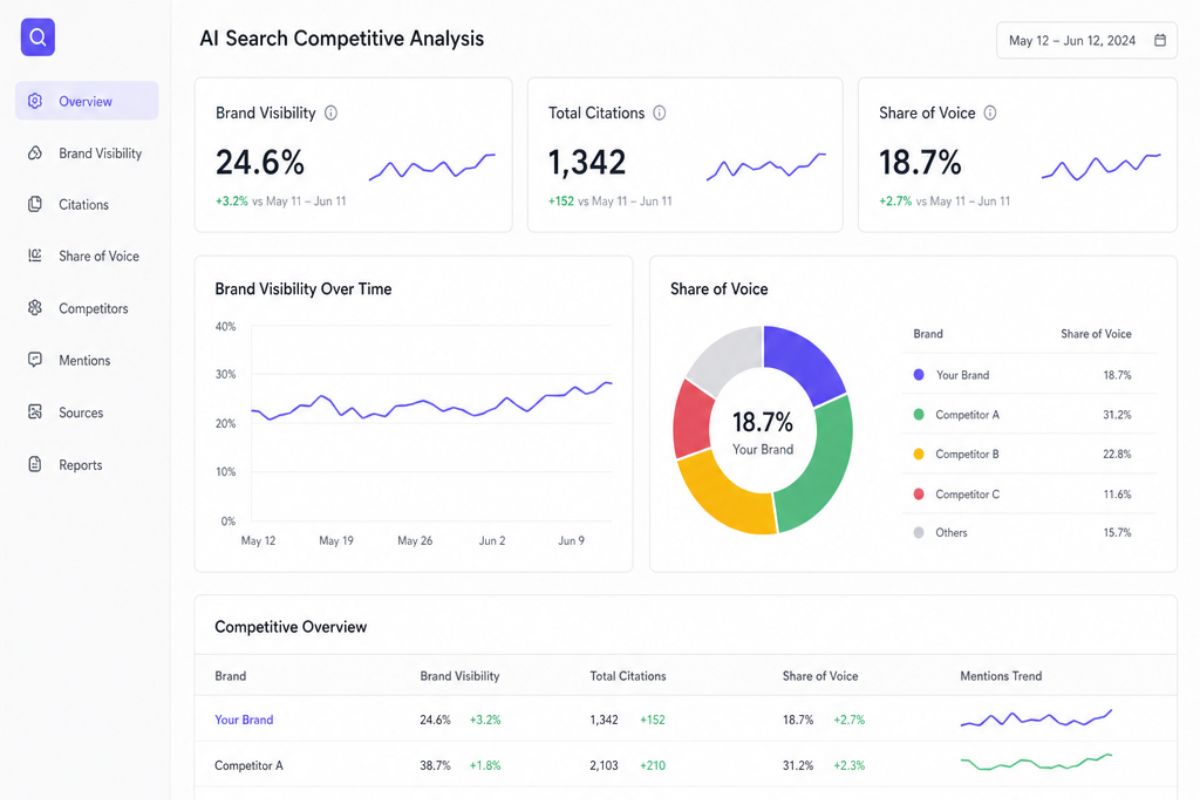

AI search is changing how buyers compare brands, shortlist vendors, and decide whom to trust. This page helps marketing, SEO, and growth teams choose practical ai search competitive analysis tools for tracking how their brand and competitors appear in ChatGPT, Google AI Overviews, Gemini, Perplexity, Copilot, and other answer engines. Use it to understand which AI analytics tools fit your workflow, what to measure, and how to turn AI visibility data into better content, citations, and market positioning.
Table of Contents
Which AI search competitive analysis tool is right for your team?
The right tool depends on your current maturity: teams starting from zero usually need prompt tracking, competitor benchmarking, and citation analysis; established SEO teams often need AI visibility data connected to keyword research, content workflows, and reporting; enterprise teams may need multi-market governance, APIs, and stakeholder-ready dashboards. In practice, the best aeo tools for competitive analysis in ai search help you answer three questions: where do competitors appear, why are they being cited, and what should you change next?
Use this shortlist as a buying guide rather than a rigid ranking. AI search visibility can vary by prompt wording, engine, location, and time, so avoid making decisions from a one-time manual check. Recent research on measuring visibility in generative engine optimization notes that one-off observations can be unreliable because answers vary across runs, prompts, and time. (arxiv.org)
The leading categories of AI search tools
AI search tools now sit between competitive seo analysis, brand monitoring, and market research ai. Some platforms are purpose-built for AI visibility, while traditional SEO suites have added AI search features to their existing keyword, backlink, and reporting systems. The best choice is the one your team will actually use every week.
1. Enterprise AI search intelligence platforms Platforms such as Profound and Conductor are built for teams that need deeper competitive benchmarking, topic-level visibility, and executive reporting. Profound says it tracks competitor performance by topic, prompt, and platform across major AI search environments including ChatGPT, Perplexity, Google AI Overviews, Gemini, Copilot, Grok, and DeepSeek. (tryprofound.com) Conductor’s AI Search Performance features focus on brand mentions, website citations, competitive share of voice, and moving from visibility opportunities into content creation. (conductor.com)
2. AI visibility trackers for marketing teams Tools such as Peec AI, OtterlyAI, Writesonic, and Rankscale focus on recurring visibility monitoring, prompt tracking, competitor comparisons, sentiment, and citation discovery. Peec AI, for example, describes side-by-side comparisons for visibility, position, sentiment, and share of voice across AI engines. (peec.ai) OtterlyAI says it monitors tracked prompts daily across ChatGPT, Google AI Overviews / AI Mode, Perplexity, Gemini, Microsoft Copilot, and Claude. (help.otterly.ai)
3. SEO suites with AI visibility layers If your team already runs SEO in Semrush or Ahrefs, adding AI visibility inside the same ecosystem can reduce tool sprawl. Semrush’s AI Visibility Toolkit includes competitor research for comparing how AI platforms position competitors against your brand. (semrush.com) Ahrefs Brand Radar tracks AI visibility across AI answers and other channels that influence discovery, including SEO, YouTube, Reddit, and TikTok. (help.ahrefs.com)
What your competitive workflow should measure
A strong AI market analysis workflow does not stop at “Are we mentioned?” Mentions matter, but competitive advantage comes from understanding which prompts create demand, which sources shape AI answers, and where your content is missing from the evidence layer.
Prioritize tools that can help you review:
- Prompt coverage: the commercial, comparison, problem-aware, and brand-specific questions buyers actually ask.
- Share of voice: how often your brand appears compared with direct competitors and emerging alternatives.
- Citation share: which domains, articles, reviews, partner pages, and category resources AI systems reference.
- Sentiment and positioning: whether AI answers describe your product accurately, favorably, and in the right category.
- Engine-level gaps: where you appear in one AI search platform but disappear in another.
- Action recommendations: whether the tool explains what to update, publish, clarify, or promote next.
This is where search optimization tools need to become operational, not just observational. A dashboard that says a competitor wins a prompt is useful; a dashboard that shows the cited sources, content gaps, and next actions is more likely to change pipeline outcomes.
Recommended tools to compare first
The market is moving quickly, but these platforms represent the main buying paths for teams evaluating ai search competitive analysis tools.
| Tool | Best fit | Competitive analysis strengths |
|---|---|---|
| Profound | Enterprise teams and AI search programs | Benchmarks competitors by topic, prompt, and platform; supports gap analysis and page-level recommendations. (tryprofound.com) |
| Semrush AI Visibility Toolkit | SEO teams already using Semrush | Compares brand presence against competitors in AI-generated search results and connects with reporting workflows. (semrush.com) |
| Ahrefs Brand Radar | SEO teams focused on broad visibility signals | Tracks brand visibility across AI answers and discovery channels, with search-backed prompts and competitor-style research. (help.ahrefs.com) |
| Peec AI | Marketing teams that want clear visibility metrics | Tracks visibility, position, sentiment, share of voice, and cited sources by engine. (peec.ai) |
| OtterlyAI | Teams starting structured AI search monitoring | Runs recurring prompt checks and tracks brand, product, and competitor mentions across major engines. (help.otterly.ai) |
| Writesonic AI Visibility Tracker | Content teams that want tracking plus action | Tracks visibility, citations, sentiment, share of voice, and competitor gaps, with filters by market, language, intent, and topic. (writesonic.com) |
| Conductor AI Search Performance | Enterprise SEO and content organizations | Connects AI visibility, competitive gaps, search intelligence, and content optimization workflows. (conductor.com) |
| Rankscale | Teams seeking an integrated GEO dashboard | Positions itself around measuring, tracking, and improving visibility across generative engines, including competitor visibility and share of AI answers. (rankscale.ai) |
A practical selection framework
Before booking demos, define the decisions the tool must support. A small B2B team may only need to know which competitor dominates “best software for…” prompts and which third-party pages AI engines cite. A larger team may need prompt groups by market, product line, funnel stage, and customer segment.
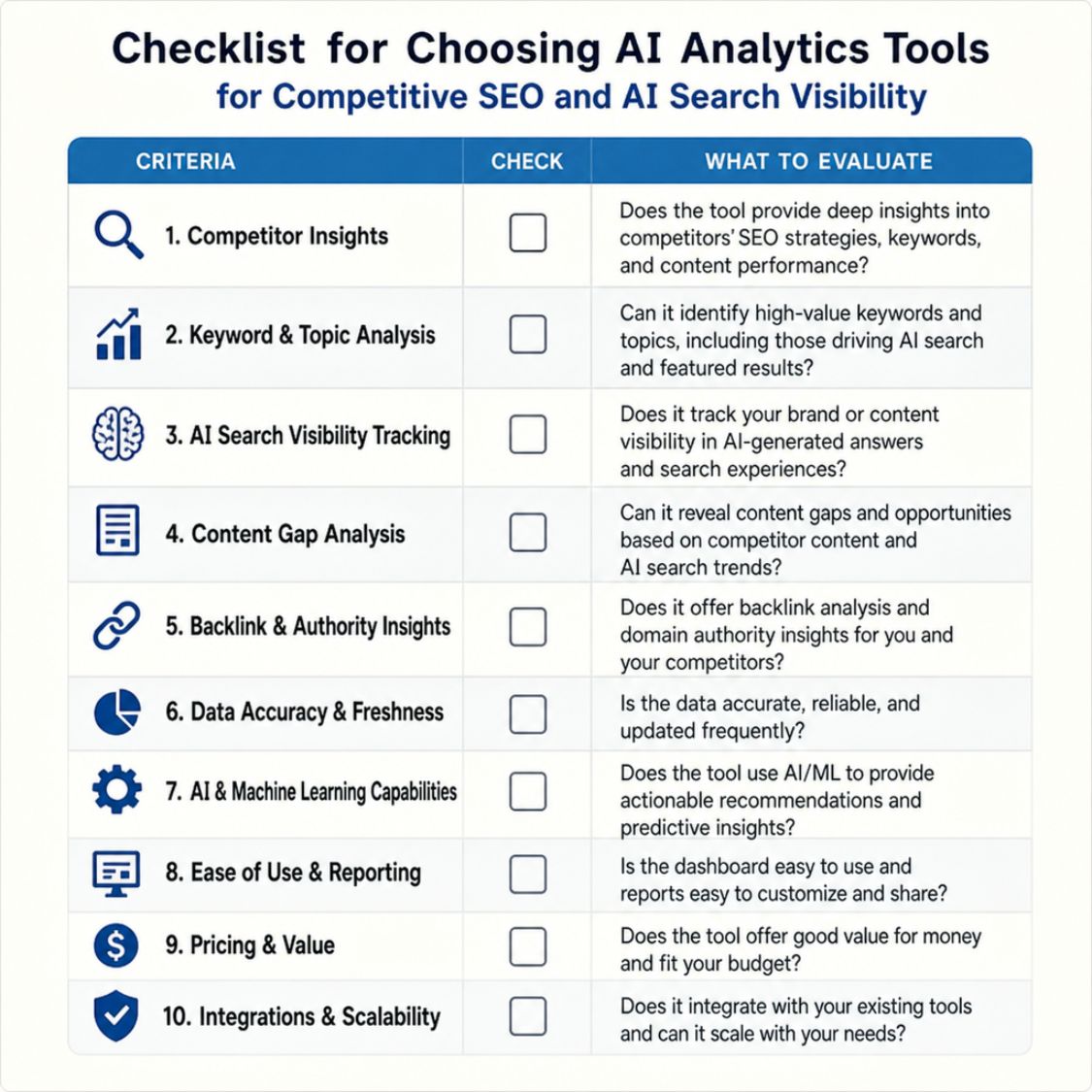
Use this checklist to narrow your shortlist:
- Map your real competitors. Include direct vendors, marketplaces, publishers, review sites, and “do nothing” alternatives that AI answers may recommend.
- Group prompts by intent. Separate informational, comparison, pricing, integration, local, and bottom-of-funnel prompts so the data is easier to act on.
- Check platform coverage. Confirm whether the tool monitors the engines your buyers use, such as ChatGPT, Gemini, Perplexity, Claude, Copilot, and Google AI experiences.
- Review citation visibility. Choose tools that show the sources behind answers, not just the final brand mention.
- Demand trend data. AI answers fluctuate, so look for daily or recurring tracking instead of static snapshots.
- Plan the action loop. Decide who will update content, pursue citations, refresh pages, and report movement.
Turn AI visibility data into content that wins comparisons
The fastest wins often come from improving assets that already have topical relevance. If competitors are cited for “best X for Y,” inspect the sources AI engines use and compare them with your own content. You may find missing comparison pages, unclear product positioning, weak authoritativeness signals, outdated documentation, or thin answers to high-intent buyer questions.
A simple before-and-after workflow looks like this: first, track ten priority prompts across your core engines; next, identify where competitors are mentioned and which pages are cited; then refresh your most relevant pages with clearer definitions, use cases, evaluation criteria, and evidence. After that, monitor whether citations, sentiment, and share of voice change over time. This connects competitive seo analysis with actual execution instead of leaving the data trapped in a dashboard.
Build your AI search analysis stack now
AI search optimization is no longer just an SEO experiment. Buyers are asking answer engines to compare options, summarize reputation, explain tradeoffs, and recommend vendors before they ever reach a website. The teams that build a repeatable measurement and action process now will be better prepared to defend visibility as search behavior continues to shift.
Start by choosing two or three tools from this page, running the same prompt set through each, and comparing the usefulness of the outputs. Look beyond the prettiest dashboard. The right ai search tools should help your team understand the market, see competitors clearly, and know what to improve next.
Ready to evaluate your AI search visibility? Build your prompt list, choose your competitive set, and start tracking where your brand is appearing, missing, and being misrepresented across AI search.
Related Posts