

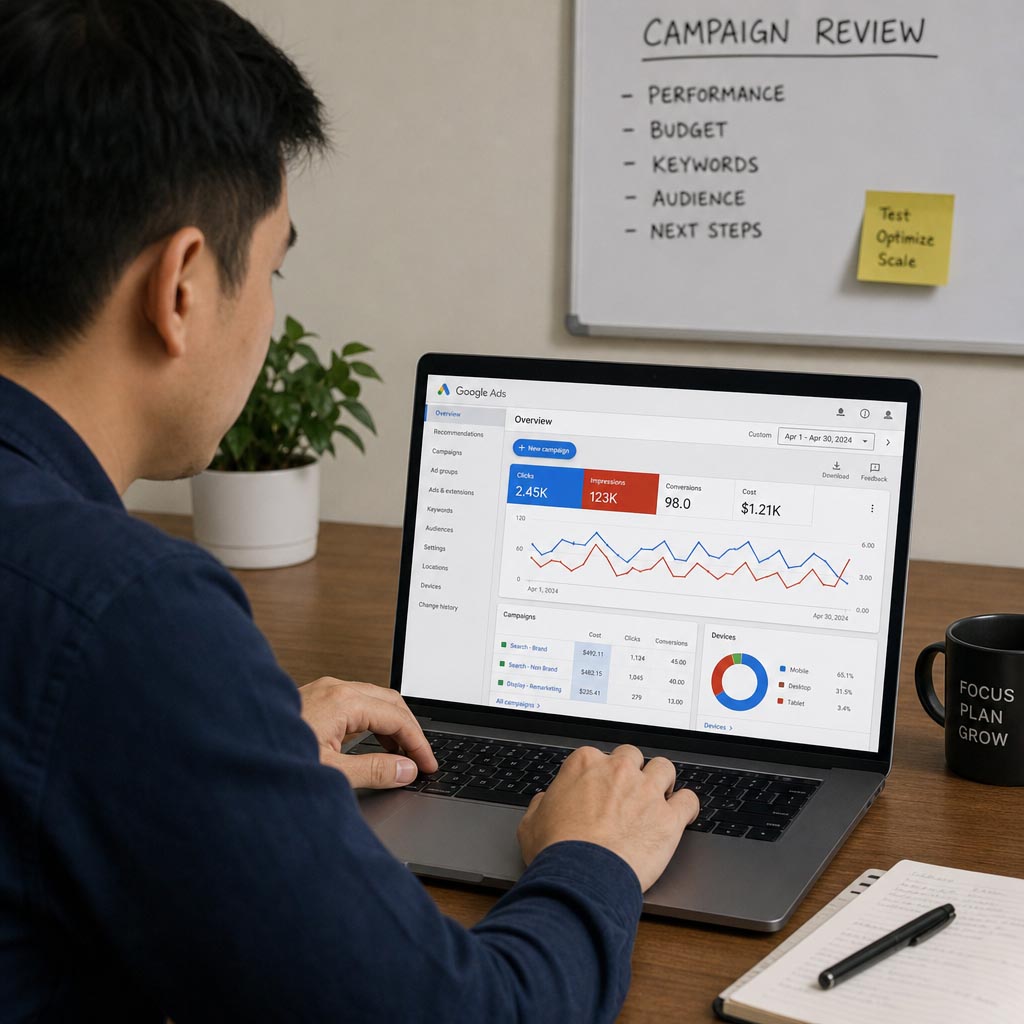

Get more from every click with Google Ads services built around qualified leads, not vanity traffic. a PC of mind helps businesses connect paid search, campaign optimization, landing pages, and practical reporting so your ad budget has a clearer job: turn high-intent searches into real conversations. If you need a Google Ads management agency in Atlanta or a nearby Georgia market, this page explains what expert management should include and how to move from scattered ad spend to a more accountable paid search system.
Table of Contents
Is your Google Ads budget producing the right kind of growth?
Your Google Ads budget is producing the right kind of growth when it brings in prospects who match your services, location, urgency, and revenue goals—not just more clicks. Strong paid search services connect keyword intent, ad copy, landing pages, call tracking, form tracking, negative keywords, and ongoing testing into one system. Without that structure, campaigns can look active while still wasting money on irrelevant searches, weak leads, or pages that do not convert.
That is why expert search engine marketing starts with business context before campaign settings. A law firm, medical practice, CPA, consultant, or local service business may all want more leads, but each needs a different mix of keywords, geography, messaging, follow-up, and budget control. a PC of mind’s own approach emphasizes clear communication and learning the business story before marketing it, which fits paid search especially well because the campaign must reflect what the business actually wants to win. (apcofmind.com)
When Google Ads is managed well, the account becomes easier to understand. You can see which services are attracting demand, which searches are wasting spend, which locations are worth pursuing, and which calls or forms deserve follow-up. The goal is not to make advertising feel complicated. The goal is to make investment decisions easier.
Paid search built for decisions, not guesswork
A professional google ads management agency should do more than launch ads and send screenshots. Your campaigns need a strategy that answers practical questions: who are you trying to reach, what problem are they searching for, what should they see first, and what action should they take next? Those answers shape the account structure, the landing page, and the way performance is reported.
For many professional services firms, Google Search Ads are valuable because they reach people who are actively looking for help. a PC of mind’s guidance on SEO and paid ads notes that responsible paid advertising includes careful keyword selection, geographic targeting, separate campaigns for priority services, conversion-focused landing pages, call and form tracking, negative keyword controls, budget monitoring, testing, and optimization. (apcofmind.com)
That full system matters because a click is only the beginning. Someone may search for an urgent service, compare two or three providers, call from a mobile phone, and make a decision within minutes. If your ad speaks to the wrong need, your landing page is vague, or your tracking cannot separate good leads from bad ones, the campaign will not show you what is really happening.
With disciplined campaign optimization, your account can become a feedback loop:
- Search terms reveal demand. Real queries show how prospects describe their problems, not how your internal team labels services.
- Ad copy tests urgency and fit. Clear messages help identify which pain points and offers earn qualified action.
- Landing pages expose friction. Forms, phone numbers, page speed, proof points, and service clarity all affect whether a visitor becomes a lead.
- Conversion tracking separates activity from opportunity. Calls, form submissions, booked appointments, and qualified inquiries matter more than raw traffic.
- Budget allocation follows evidence. Better-performing services, locations, and devices can earn more investment while weak areas are reduced or rebuilt.
That is the difference between simply buying traffic and running paid search as a growth channel.
A clearer path from click to qualified lead
A strong Google Ads program is not one campaign, one ad, or one dashboard. It is a path. The prospect has a problem, searches for help, sees your message, lands on a focused page, and chooses whether to contact you. Every step either increases confidence or creates doubt.
A ppc management agency should examine that full path before increasing spend. If your website is slow, your offer is unclear, your intake process is inconsistent, or your landing page asks visitors to do too much thinking, more traffic may only multiply the waste. Paid ads can create visibility quickly, but they cannot fully compensate for weak messaging, broken forms, or poor follow-up.
Here is what a practical paid search path should include:
- Intent-matched keywords. Campaigns should separate brand searches, high-intent service searches, competitor or comparison searches where appropriate, and lower-intent research terms.
- Focused geographic targeting. A google ads management agency in Atlanta should understand when a campaign needs city-level, radius-based, county-level, or regional targeting.
- Specific ad groups. Broadly mixing services often weakens relevance. Each priority service should have its own message and destination.
- Useful negative keywords. Exclusions help prevent ads from showing for jobs, free resources, DIY searches, unrelated industries, and low-fit queries.
- Conversion-focused landing pages. The page should answer the visitor’s immediate question, reduce uncertainty, and make the next step obvious.
- Call and form tracking. Reporting should show not only that conversions happened, but whether they were useful.
- Routine optimization. Search terms, bids, budgets, copy, audiences, and landing page behavior should be reviewed consistently.
This is where a marketing agency with both digital strategy and technical awareness can be useful. a PC of mind presents itself as a provider of IT services and digital marketing support, with services spanning managed IT, cybersecurity, cloud, and digital growth. That combination matters when your growth channels depend on reliable websites, tracking, forms, security, and business systems working together. (apcofmind.com)
Google Ads management with a business-first foundation
The most expensive Google Ads mistake is not always a high cost per click. It is paying for attention before your business knows what to do with it. Campaigns should be built around the services you want to grow, the clients you can serve well, and the economics of your business.
Before launching or rebuilding campaigns, a PC of mind-style strategy keeps the work simple and grounded. No inflated jargon. No “set it and forget it” shortcuts. Just a clear look at where demand exists, what the business can support, and what the campaign needs to measure.
A focused setup may include:
- Goal definition: Decide whether the campaign should drive calls, consultation requests, booked appointments, quote requests, or another measurable action.
- Service prioritization: Identify which services deserve paid promotion based on margin, capacity, urgency, market demand, and follow-up ability.
- Audience and location planning: Match ads to the places and people most likely to become qualified opportunities.
- Messaging development: Turn business strengths into search-friendly copy that speaks to the prospect’s immediate concern.
- Landing page review: Confirm that the destination page supports one clear action instead of sending visitors into a general website maze.
- Tracking preparation: Set up or review the systems needed to measure meaningful conversions.
- Reporting cadence: Establish what will be reviewed, how often, and what decisions the data should support.
This kind of preparation may feel slower than simply turning on ads. In practice, it prevents wasted budget and reduces the need for expensive cleanup later. Paid search rewards clarity.
Campaign optimization that protects your spend
Campaign optimization is not a one-time tune-up. Search behavior changes, competitors adjust their messaging, costs shift, and Google’s ad platform continues to evolve. Your campaigns need someone watching for patterns, not just reacting when results drop.
A useful optimization process looks at both the account and the business outcome. A cheap lead that never becomes a real opportunity may be less valuable than a more expensive inquiry from the right buyer. A campaign with fewer clicks may outperform a busier campaign if it brings in stronger calls. The right reporting should make those tradeoffs visible.
Key optimization areas include:
- Search term cleanup: Review the actual phrases people typed before clicking and exclude poor-fit searches.
- Keyword refinement: Pause or adjust keywords that spend without producing quality conversions.
- Ad copy testing: Compare headlines, descriptions, offers, and calls to action to improve relevance.
- Bid and budget adjustments: Shift spend toward services, devices, locations, and times that show stronger performance.
- Landing page improvements: Test clearer headlines, stronger service explanations, simplified forms, and more visible contact options.
- Conversion quality review: Compare campaign data against sales or intake feedback so reporting reflects real opportunities.
- Competitive observation: Watch how search results change and adjust positioning when the market gets more crowded.
Optimization also means knowing what not to chase. A campaign can generate impressions, clicks, and even forms while still missing the business goal. Expert google ads services keep the focus on the action that matters most.
A smarter role for AI in paid advertising
AI can help automate parts of Google Ads and Meta campaign management, but it should not replace strategy, judgment, or accountability. The phrase “ai automate meta google ads management agency” reflects what many businesses are looking for: more efficient campaign management across ad platforms without losing human oversight. That is a fair goal, as long as automation is used carefully.
Automation can support bidding, creative variation, audience signals, reporting, and pattern recognition. It can also accelerate waste if the campaign is built around unclear goals or poor conversion data. If an algorithm is told to find more conversions but the account counts every weak form fill as equal, it may optimize toward quantity rather than quality.
A responsible approach uses AI where it helps and human review where it matters:
- Use automation to process patterns faster. Let platform tools assist with bidding signals, budget pacing, and creative testing where appropriate.
- Keep humans responsible for strategy. Service priorities, lead quality, geographic fit, compliance concerns, and business context require judgment.
- Feed the system better data. Conversion tracking should distinguish valuable actions from low-quality activity whenever possible.
- Review recommendations before applying them. Platform suggestions can be useful, but they are not automatically aligned with your profit, capacity, or brand.
- Connect search and social thoughtfully. Google Ads may capture high-intent demand, while Meta can support awareness, retargeting, and audience education when the offer fits.
Google’s search experience is also changing. Google’s own Ads Help documentation notes that eligible ads can appear above or below AI Overviews in markets where AI Overviews are available, and that ads in AI Overviews are still in early stages. (support.google.com) That makes disciplined measurement even more important because visibility, click behavior, and buyer journeys may continue to shift.
Built for Atlanta-area businesses and professional services
If you are searching for a google ads management agency in Atlanta, you likely want more than technical account work. You want a partner who understands local competition, lead quality, service-area targeting, and the reality that not every click is worth paying for.
Atlanta-area and Georgia businesses often compete across a mix of local, regional, and niche searches. A medical practice may care about a tight radius around its office. A law firm may target specific counties or case types. A CPA or consultant may serve clients across a wider metro area but only want inquiries from certain industries or business sizes. The campaign should reflect those differences.
A practical paid search strategy can support:
- Professional services firms that need consultation requests from people with urgent, specific problems.
- Local service businesses that depend on calls, booked appointments, and service-area relevance.
- Healthcare and wellness practices that need careful messaging and location clarity.
- B2B providers that want fewer but better-fit inquiries from defined industries or decision-makers.
- Growing businesses that need to test a new market, service line, or offer before committing to a broader campaign.
A PC of Mind’s content frequently speaks to law firms, medical practices, accounting firms, and other organizations that need both digital visibility and dependable technology foundations. Its guidance on modern search visibility also emphasizes that paid search should be measured by qualified consultation requests, phone calls that meet your criteria, cost per qualified lead, cost per signed client or scheduled patient, and revenue where possible. (apcofmind.com)
That measurement mindset is essential. The campaign is not successful because it is busy. It is successful when the right people take the right next step.
What you should expect from a Google Ads expert
A Google Ads expert should bring structure, transparency, and practical recommendations. You should not have to guess what is being tested, why the budget changed, or whether leads are improving. The work should be visible enough to build trust and clear enough to support decisions.
When evaluating a ppc management agency, look for the following signs:
- They ask about your business before talking about tactics. Good paid search begins with services, margins, capacity, geography, and lead quality.
- They separate strategy from ad spend. Management fees and media budgets should be discussed clearly so you understand where money goes.
- They care about landing pages. Sending paid traffic to a weak page is one of the fastest ways to waste spend.
- They track calls and forms. If the campaign cannot measure action, it cannot be optimized responsibly.
- They review search terms. This is where wasted spend and new opportunities often appear.
- They explain performance in plain language. Reports should connect data to decisions, not hide behind platform jargon.
- They are honest about timelines. Paid search can create visibility quickly, but useful optimization takes data, testing, and follow-through.
You should also expect recommendations that sometimes reduce spend, narrow targeting, or pause underperforming ideas. That can feel counterintuitive, but disciplined advertising is not about spending more everywhere. It is about investing where the evidence is strongest.
Your website and technology affect ad performance
Paid search does not operate in isolation. The ad account may bring visitors in, but your website, forms, phone system, CRM, analytics, and internal follow-up determine whether that attention becomes revenue. A slow page, broken form, confusing mobile experience, or missed call can turn a good click into a lost opportunity.
This is one reason a PC of mind’s blend of IT services and digital growth is relevant for businesses that care about ROI. The company’s site describes managed IT, backup and recovery, cybersecurity, and digital growth support, and its resource content connects digital visibility with the importance of reliable infrastructure. (apcofmind.com)
Before scaling paid ads, it is worth reviewing:
- Page speed and mobile usability: Most prospects will not wait patiently for a slow or awkward page.
- Form reliability: A form that fails silently can make a campaign look ineffective while leads are simply being lost.
- Call routing: If calls ring to the wrong person or go unanswered, campaign data will not tell the whole story.
- Analytics setup: Clean tracking helps distinguish between real leads and accidental clicks.
- Security and trust signals: Visitors need confidence before sharing information or requesting help.
- Follow-up process: Speed, clarity, and consistency after the conversion can affect whether the lead becomes business.
This is the practical side of maximizing ROI. Better ads help. Better systems help those ads produce more value.
The engagement starts with clarity
The best time to improve Google Ads is before more money is wasted. Whether you already have campaigns running or you are preparing to launch, the first step is to understand what is working, what is unclear, and what should happen next.
A clear first conversation can cover:
- Your current goal: More calls, more booked appointments, more consultations, more quote requests, or better lead quality.
- Your priority services: The offers that deserve visibility because they support growth and can be fulfilled well.
- Your target geography: Atlanta, surrounding Georgia communities, service areas, or broader regional markets.
- Your current marketing mix: SEO, referrals, website traffic, Meta ads, email, local search, or existing Google Ads campaigns.
- Your tracking gaps: Calls, forms, CRM status, lead quality, revenue attribution, or reporting clarity.
- Your next decision: Audit, rebuild, launch, test, or pause until the foundation is ready.
From there, the recommendation should be straightforward. Some businesses need a full campaign rebuild. Some need landing page improvements first. Others need tracking repaired before performance can be trusted. The right answer depends on the account, the website, and the business objective.
Turn paid search into a measurable growth channel
You do not need another confusing dashboard. You need a paid search strategy that makes your next decision easier. With the right google ads management agency, your campaigns can move from reactive spending to focused investment—built around real search intent, clear landing pages, reliable tracking, and ongoing campaign optimization.
If you are ready to improve Google Ads performance, compare paid search to SEO, or build a stronger search engine marketing plan, start with a practical review. a PC of mind can help you look at the full path from search to lead, including the technology and website details that influence results. Explore the company’s digital growth perspective and service approach through its internal resources on SEO versus paid ads and search visibility, then take the next step toward a campaign that is easier to measure and easier to trust. (apcofmind.com)
Ready to get more value from your ad spend? Contact a PC of mind to discuss Google Ads management, paid search services, and a clearer plan for turning high-intent searches into qualified opportunities.