

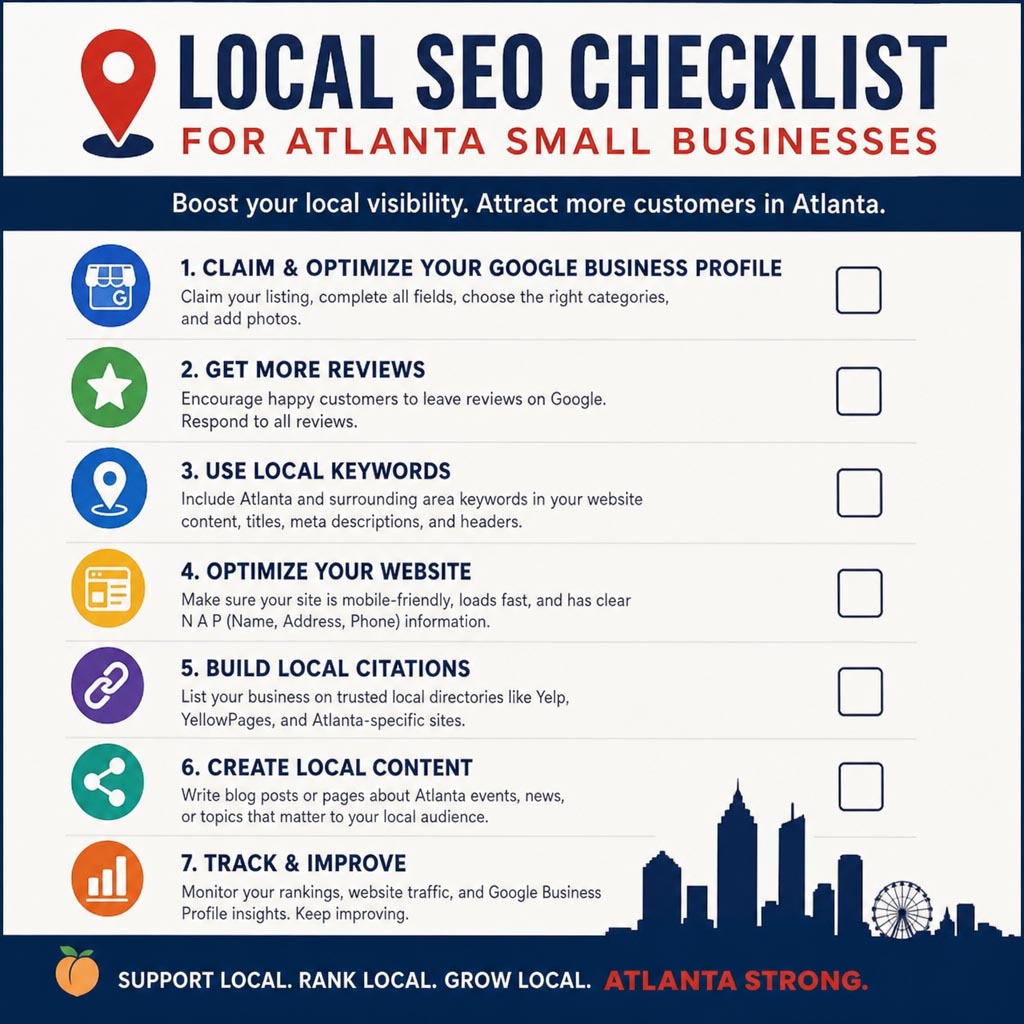

Local SEO is the practice of making your business easy to find, trust, and contact whenever someone nearby searches for what you offer — on Google Search, Google Maps, voice assistants, and increasingly on AI-generated answers from tools like AI Overviews, ChatGPT, and Gemini. For small and medium businesses, it remains one of the most practical ways to compete, because it focuses on people who are already looking in a specific area and are close to taking action: calling, booking, requesting a quote, or walking in the door.
At a PC of mind, we look at local SEO as more than a marketing task. Your website’s technical health, your Google Business Profile, your reviews, and the AI systems now summarizing search results all have to work together. That is why we built our AEO, SEO & GEO services for local growth on top of a stable, secure technical foundation instead of treating search visibility as a separate, disconnected project.
Quick answer: Local SEO is important because most buying decisions today start with a location-based search — even when the customer never types a city name. Search engines and AI assistants use signals like relevance, proximity, prominence, and technical health to decide which businesses get recommended. Strong, consistent signals mean more calls, more direction requests, and more qualified customers who were already looking for you.
Table of Contents
Why Is Local SEO Important?
Local SEO is important because it reduces the friction between a search and a decision. A homeowner searching for an emergency plumber, a parent looking for a nearby tutor, or a patient searching for a dentist “near me” is not casually browsing — they already have intent. If your hours, services, reviews, photos, contact details, and website all tell the same accurate story, that customer can move from discovery to action with confidence, instead of bouncing to a competitor with clearer information.
This matters more than ever because search itself has split into several parallel paths. The table below shows how customers now find local businesses, and what each path expects from you.
| How customers search today | Example query | What it means for your business |
|---|---|---|
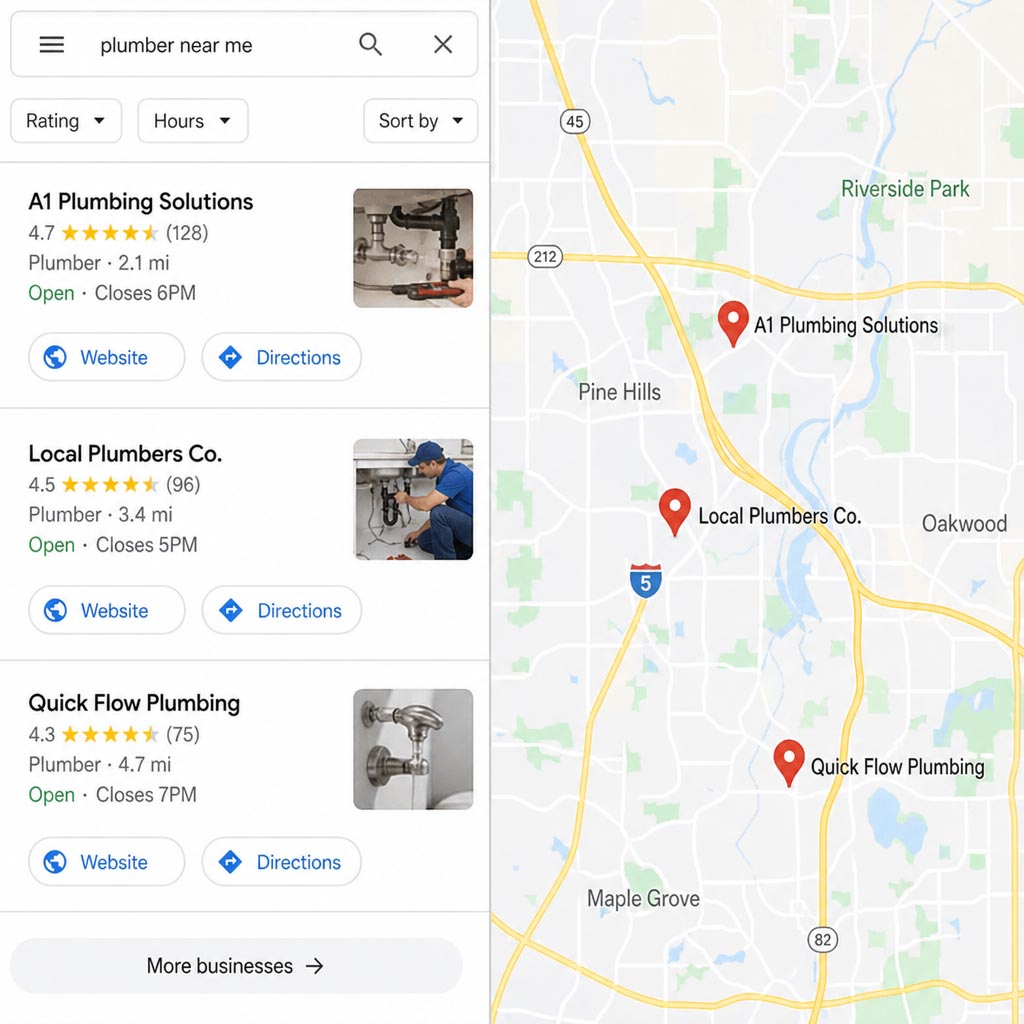
| Traditional search & the Map Pack | “plumber near me” | Accurate categories, complete Google Business Profile, and strong reviews still decide who appears in the top 3 map results. |
| Voice assistants | “Find a dentist open now” | Voice answers are pulled from businesses that already rank well in traditional local search, so the fundamentals still come first. |
| AI chat & AI Overviews | “Best family lawyer in Fayette County” | AI systems favor businesses with clear, consistent information and content that directly answers the question being asked. |
| Reviews & social platforms | Checking star ratings before calling | Recent, genuine reviews confirm — or contradict — everything else the customer just read. |
Local Search Has Changed How Customers Choose Businesses
People no longer rely only on word of mouth, storefront signs, or printed directories. They compare local businesses in seconds across search results, maps, review platforms, and AI-generated summaries. Nearly half of consumers now say they always or often add “near me” to a search (BrightLocal, via The Stacc, 2026), and when they do, the results move fast: roughly 76% of “near me” mobile searches lead to a visit within 24 hours (Lifted Websites, 2026). That is not casual research — that is a buying decision already in motion.
Your online presence is often the first impression a customer forms before they ever speak with your team. A business with complete listings, helpful service pages, strong reviews, and accurate contact details looks more credible than one with missing or outdated information — even if the underlying quality of service is identical. Local search also supports discovery beyond your brand name: many customers search by need (“accountant near me,” “roof repair in my area”) rather than by business name, and local SEO is what lets you show up for people who don’t know you exist yet.
The Core Benefits of Local SEO for Growing Businesses
The value of local SEO goes beyond a higher ranking. It supports every stage of the customer journey and makes your other marketing more effective, because people who hear about you elsewhere can still find reliable information when they search.
| Benefit | Why it matters | Example outcome |
|---|---|---|
| Higher visibility in nearby searches | You appear when people search for your services or business type in your area | More impressions in the Map Pack and local organic results |
| More qualified traffic | Local searches carry immediate or near-term intent | Fewer wasted clicks from people outside your service area |
| Increased calls, visits, and bookings | Optimized listings and pages remove friction from the next step | More phone calls and form submissions without added ad spend |
| Stronger trust signals | Reviews, accurate details, and photos reassure customers you’re active and legitimate | Higher click-through and lower bounce from search results |
| Better competitiveness against larger brands | Local relevance lets smaller businesses win in a defined service area | Ranking above national chains for neighborhood-level searches |
| Improved customer experience | Clear hours, services, and contact options save the customer time | Faster decisions and fewer support calls asking basic questions |
These benefits matter most when your business depends on a defined geographic market — restaurants, medical offices, law firms, contractors, retailers, salons, repair services, agencies, and most professional service providers.
Why Local SEO Matters Most to Small and Medium Businesses
Local SEO focuses marketing effort where a small or medium business can realistically win: the communities, neighborhoods, and service areas it actually serves. Instead of trying to attract everyone, it makes you visible to the people most likely to contact or visit. A neighborhood dental office does not need to rank nationally. A home services company does not need traffic from cities it cannot serve. It needs the right customers, nearby, at the right moment.
This is also why local SEO matters for businesses that depend on repeat customers and reputation. It reinforces word of mouth: if someone hears your name from a friend and searches for you, a strong local presence confirms the recommendation. If they search by need instead of name, your presence gives you a chance to earn their attention before a competitor does. This is the exact gap we help close for the small businesses, contractors, healthcare practices, and professional firms we work with across Georgia.
The Three Signals That Shape Local Search Visibility
No single factor guarantees a top position, and results shift depending on the searcher’s location, device, and intent. Still, three core signals consistently matter for local search — and now for AI-driven search as well.
| Signal | What it means | How to strengthen it |
|---|---|---|
| Relevance | How closely your business matches what the searcher wants | Accurate categories, clear service descriptions, and language that matches how customers actually ask (not internal jargon) |
| Proximity | How close your business or service area is to the searcher | Accurate address and service-area details, consistent across your website and listings |
| Prominence | How well known, reviewed, and referenced your business appears to be | Consistent reviews, local citations, press mentions, and links from real community relationships |
Prominence, in particular, is built over time through real customer experiences and consistent reputation management — which is why local SEO is both a technical discipline and a relationship-building effort.
Local SEO Is No Longer Just About Google: Winning in AI Chat and Generative Search
Local search has quietly split into three connected disciplines: SEO (ranking in traditional search and maps), AEO — Answer Engine Optimization (being the answer voice assistants and AI Overviews give), and GEO — Generative Engine Optimization (being cited or recommended by generative AI tools like ChatGPT, Gemini, and Perplexity). Google’s own AI-generated answers went from appearing on roughly 15% of searches to 43% in just over a year (TechCrunch, July 2026), and BrightLocal’s 2026 research found that 45% of consumers have used an AI tool such as ChatGPT, Google AI Mode, or Gemini to find a local business in the past year — up from just 6% the year before (Branding Zombie Designs, 2026).
The practical takeaway: your business now has to be legible to algorithms and to language models at the same time. That does not mean starting over — it means building on the same fundamentals with a few AI-specific habits layered in.
| Discipline | Primary focus | Where it shows up | What helps it most |
|---|---|---|---|
| SEO | Ranking in organic search and the Map Pack | Google Search, Bing, Maps | On-page optimization, backlinks, technical site health |
| AEO | Being selected as “the” answer | AI Overviews, voice assistants, featured snippets | Direct, concise answers; clean structure; FAQ content |
| GEO | Being cited or recommended by generative AI | ChatGPT, Gemini, Perplexity, Copilot | Entity consistency, structured data, quotable content, credible citations |
Practical steps that support AEO and GEO alongside traditional local SEO include:
- Answer the question in the first sentence. Put the direct answer to each heading immediately underneath it — AI systems tend to quote the first clear sentence, not the fifth paragraph.
- Use structured data. Schema markup for your business, services, reviews, and FAQs helps both search engines and AI systems parse your content accurately.
- Keep your business “entity” consistent everywhere — name, address, phone, categories, and descriptions should match across your website, Google Business Profile, and directories, since AI tools cross-reference these sources to judge credibility.
- Write content that is easy to quote. Clear definitions, short lists, and specific numbers get pulled into AI answers far more often than vague marketing language.
- Earn genuine citations and reviews. AI tools weigh third-party validation heavily — press mentions, directory listings, and real reviews all function as trust signals for generative engines, not just search engines.
This is exactly what our AEO, SEO & GEO services for local growth are built to do — treat search engines, maps, voice, and AI-driven platforms as one unified strategy instead of separate projects.
Core Local SEO Strategies That Build Long-Term Momentum
Effective local SEO strategies reinforce one another. Your website should support your business profile, your listings should match your real-world details, your content should answer local customer questions, and your reviews should reflect the experience you actually deliver.
1. Optimize Your Google Business Profile
For most businesses, the Google Business Profile is the single most visible local search asset — it appears in map results, branded searches, and discovery searches. Complete, accurate profiles convert at roughly 4.5%, compared to about 1.8% for incomplete or unverified listings (KJPro Web, 2026).
| Profile element | Why it matters |
|---|---|
| Primary & secondary categories | Tells search engines exactly what you do — vague categories create confusion |
| Name, address, phone, hours | Incorrect details can cost you a visit or a lead in real time |
| Service areas | Critical for businesses without a public storefront |
| Business description | Written for customers first, not keyword-stuffed for search engines |
| Service/product listings | Should reflect what people can actually buy or book today |
| Photos | Show your location, team, and work — builds trust before first contact |
| Regular updates | Hours, offerings, and details should be refreshed as soon as they change |
2. Build Location-Focused Website Pages That Are Genuinely Useful
Your website gives you room to explain what your listings cannot. Good local pages include the service offered, the area served, who the service is for, common customer problems, what the customer can expect, clear contact options, and internal links to related services. Avoid thin pages that simply swap city names — local content should be specific enough to actually help someone decide.
3. Keep Business Information Consistent Everywhere (NAP)
Your business name, address, phone number, website, and hours should match exactly across your website, Google Business Profile, directories, and social platforms. Inconsistent information confuses customers, weakens search trust, and — increasingly — confuses the AI systems that cross-check these details before recommending you. A periodic citation audit is worth the time, especially after a move, rebrand, or phone number change.
4. Earn and Manage Customer Reviews the Right Way
- Ask at the best moment — right after a successful appointment, purchase, or completed project.
- Make it effortless: send a direct link instead of asking customers to search for your review page.
- Avoid incentives or scripted language that could make reviews feel unnatural or violate platform rules.
- Respond to every review, positive or negative, in a timely and respectful way.
- Track recurring themes in feedback to improve operations, not just your star rating.
5. Create Content That Answers Local Intent
Local content should help someone make a decision — not just fill a page. A contractor might explain how seasonal weather affects repairs in the area. A dental practice might explain what first-time patients should bring (see how we approached this for a client in our guide on maximizing a dental practice’s online visibility). Helpful content builds familiarity with searchers who aren’t ready to call yet — and it is exactly the kind of specific, well-structured content that AI systems prefer to cite.
6. Develop Local Links and Community Signals
Local links from chambers of commerce, business associations, sponsorships, schools, and community partners connect your business to a real place — and they carry referral traffic from people who already trust the source. The best local links come from real relationships, not shortcuts: sponsor an event, collaborate with another local organization, or contribute to a community project, and make sure the resulting mention lists your details accurately.
A Practical Local SEO Checklist for 2026
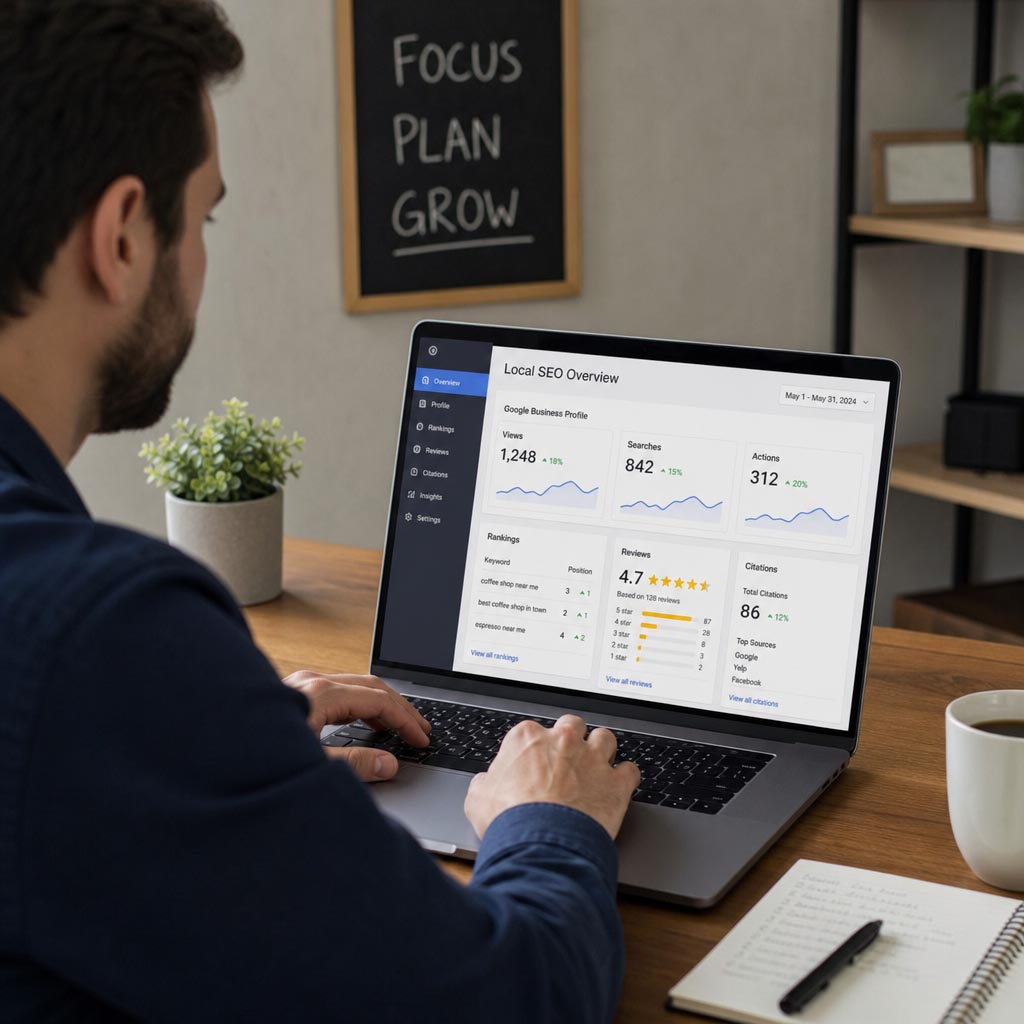
Treat local SEO as an ongoing system rather than a one-time setup. Use this checklist to identify gaps and prioritize your next move.
| Action | Priority |
|---|---|
| Confirm your name, address, phone, hours, and service areas everywhere | Foundational |
| Review and correct your Google Business Profile categories | Foundational |
| Add clear calls to action (call, book, get directions, message) | Foundational |
| Improve website structure so each service/location has real content | Ongoing |
| Use local language naturally, not as repeated filler | Ongoing |
| Publish helpful local content that answers real customer questions | Ongoing |
| Monitor and respond to reviews consistently | Ongoing |
| Add structured data / schema markup for AEO and GEO visibility | Advanced |
| Audit citations for name/address/phone consistency | Advanced |
| Track calls, direction requests, and form submissions — not just rankings | Advanced |
How to Measure Local SEO Performance
Local SEO should be measured by business outcomes, not vanity metrics. A page that ranks well but generates no calls or bookings needs stronger messaging or a clearer conversion path — not just more traffic.
| KPI | What it tells you | Where to check it |
|---|---|---|
| Calls from listings & website | Whether visibility is converting to direct contact | Google Business Profile insights, call tracking |
| Direction requests | Real-world intent to visit your location | Google Business Profile insights |
| Website visits from local queries | How well your content matches local search demand | Google Search Console, analytics |
| Form submissions / bookings | Whether your site converts local visitors into leads | Website analytics, CRM |
| Review volume & rating trend | Ongoing reputation and prominence signal | Google, Yelp, industry platforms |
| Branded vs. non-branded visibility | Whether you’re reaching new customers, not just existing ones | Search Console query reports |
Common Local SEO Mistakes That Limit Growth
| Mistake | Why it hurts you | Quick fix |
|---|---|---|
| Website and Google Business Profile don’t match | Weakens relevance signals for both search engines and AI systems | Align services, categories, and descriptions across both |
| Generic content (“quality service, affordable prices”) | Could describe any business in any city — gives no reason to choose you | Name the specific service, problem, area, and next step |
| Reviews ignored until something goes wrong | Creates a thin, reactive reputation instead of a balanced one | Build review requests into your normal customer process |
| Inconsistent business name across platforms | Confuses citation-matching and hurts prominence | Standardize your exact name everywhere, including punctuation |
| Duplicate listings for the same location | Splits reviews and confuses search engines | Merge or remove duplicates via Google Business Profile support |
| Thin city pages that just swap the city name | Provides little unique value — and gets ignored by both users and AI | Add real local detail: service areas, local context, specific proof |
| Neglecting mobile usability and page speed | Most local searches happen on mobile — slow sites lose the click | Run a technical audit and fix the largest speed issues first |
| Hiding your phone number or contact options | Adds friction at the exact moment intent is highest | Put a click-to-call number and simple contact form on every page |
How to Choose Your Local SEO Priorities Right Now
Start with the customer’s path from search to action. Identify what people need to know, where they’re likely to search, what might stop them from contacting you, and which signals are currently weakest — then work in this order:
- Fix accuracy first. Incorrect details block customers immediately, so resolve them before advanced tactics.
- Clarify what you offer. Make sure categories, service pages, and profile descriptions match real customer searches.
- Improve trust. Add reviews, photos, team information, and clear expectations.
- Strengthen local and AI relevance. Build useful location content and add structured data so both search engines and AI tools understand you clearly.
- Measure and refine. Use calls, bookings, and qualified leads — not rankings alone — to guide ongoing improvements.
For a deeper framework on evaluating priorities or potential SEO partners, see our guide on how to choose the best SEO company in Atlanta.
How a PC of Mind Helps Local Businesses Become the First Answer
Most companies choose between a managed IT provider or a marketing agency. With a PC of mind, you don’t have to. We built our foundation on IT stability — secure infrastructure, proactive monitoring, and system optimization — and integrated digital growth expertise directly into that foundation. The result is a partner who understands both the backend architecture and the front-facing brand, and how the two influence each other. Your search optimization is built on a technically sound site, not a fragile one.
Our AEO, SEO & GEO services for local growth are designed to make your business the first answer across search engines, maps, voice assistants, and AI-driven summaries — for small businesses, local service providers, professional firms, and growing brands across Georgia, including Senoia, Fayetteville, Peachtree City, Newnan, and the greater Atlanta metro area (Midtown, Buckhead, Decatur, Sandy Springs, Marietta, and Alpharetta).
| What we do | How it helps your local visibility |
|---|---|
| Local SEO & Google Business Profile optimization | Stronger map-pack rankings and more accurate customer information |
| AEO & GEO structuring (schema, FAQs, entity consistency) | Better odds of being cited by AI Overviews, ChatGPT, and Gemini |
| Website development & technical health | Fast, secure, mobile-friendly pages that both customers and search engines trust |
| Managed IT & secure infrastructure | Your site stays “always on” — no downtime undoing your SEO progress |
| Content & brand building | Consistent messaging across every platform, on-page and off-page |
We are not just an SEO vendor — we are a technology and digital growth partner. If you’re ready to see where your business currently stands, visit our Local Growth page to explore AEO, SEO & GEO services and send an inquiry through the site. From there, we’ll schedule a conversation to review your goals, current visibility, and best next steps. You can also browse our related guides on top-rated digital marketing services in Atlanta or check our general FAQ page for common questions about working with us.
Local SEO Supports Long-Term Business Growth
Local SEO becomes a durable growth channel because it compounds over time. Each accurate listing, useful page, genuine review, and improved customer interaction adds to your business’s online footprint. It also protects the demand you already have: when a referral, an ad click, or a social media follow leads someone to search for you, a strong local presence confirms the recommendation instead of creating doubt. Keep your information accurate, explain your services clearly, ask for reviews naturally, and build pages that help real people decide — over time, these habits turn local SEO from a marketing task into a growth system.
Frequently Asked Questions About Local SEO in 2026
What is local SEO, and why does it matter in 2026?
Local SEO is the process of optimizing your online presence so nearby customers can find, trust, and contact your business when they search. In 2026, it matters even more because search now spans traditional results, maps, voice assistants, and AI-generated answers — and businesses with accurate, consistent information across all four are the ones that get recommended.
How is AI changing local SEO?
AI Overviews, ChatGPT, and Gemini increasingly answer local questions directly instead of just listing links. Google’s AI-generated answers went from appearing in about 15% of searches to 43% within a year (TechCrunch, 2026), which means businesses now need clear, structured, quotable content — not just keyword-optimized pages — to get recommended.
What is the difference between SEO, AEO, and GEO?
SEO focuses on ranking in traditional search results and maps. AEO (Answer Engine Optimization) focuses on being selected as the direct answer in AI Overviews and voice search. GEO (Generative Engine Optimization) focuses on being cited or recommended by generative AI tools like ChatGPT and Gemini. They overlap heavily and should be built as one connected strategy, not three separate projects.
Is a Google Business Profile still important now that AI search is growing?
Yes — it may be more important than ever. AI systems pull heavily from Google Business Profile data to answer local questions, and fully optimized profiles convert at roughly 4.5%, compared to about 1.8% for incomplete listings (KJPro Web, 2026). A weak profile weakens both your map ranking and your odds of being recommended by AI.
How long does local SEO take to show results?
Most businesses start seeing meaningful movement within 3 to 6 months, depending on competitiveness and how strong the existing foundation is. Fixing accuracy issues and profile gaps can produce faster wins, while building authority, reviews, and AI visibility is a longer-term, compounding process. Any provider promising page-one rankings within days should raise a flag.
Do voice assistants use different ranking signals than regular search?
Not entirely — voice answers are largely pulled from businesses that already rank well in traditional local search. Consumers who use voice search for local businesses often act fast: nearly 6 in 10 use it to find hours, directions, or contact details directly (The Stacc, 2026), so accuracy and completeness matter as much for voice as for typed search.
Do I still need a website if my Google Business Profile already ranks well?
Yes. Your profile can only show limited information, and it can’t explain your services, answer detailed questions, or build the kind of structured, quotable content that AI tools prefer to cite. A strong website and a strong profile should reinforce each other, not compete.
How many reviews does a small business need for local SEO?
There’s no fixed number — consistency matters more than volume. A steady, ongoing flow of genuine reviews (rather than a one-time push) signals to both customers and search engines that your business is active and trusted right now, not just in the past.
Should a service-area business without a storefront still invest in local SEO?
Yes. Service-area businesses need to make their coverage area clear on their website and Google Business Profile, even without a public address. Proximity signals still apply — search engines and AI tools need to understand where you actually work, not just where you’re registered.
How much does local SEO cost for a small business?
Costs vary widely based on competitiveness, current site health, and scope — from a focused starter plan addressing profile and listing accuracy, to a fuller ongoing campaign covering content, technical SEO, and AEO/GEO structuring. A transparent provider should explain what’s included at each level rather than quoting a single flat number with no context.
How can I make my business show up in AI-generated answers?
Keep your business name, address, phone, and categories identical everywhere; add structured data (schema markup) for your business, services, and FAQs; write content that answers questions directly in the first sentence; and earn genuine reviews and citations. AI tools reward clarity and consistency over keyword density.
Ready to Become the First Answer Your Customers See?
If your business isn’t showing up where your customers are actually searching — on Google, on Maps, through voice assistants, or in AI-generated answers — now is the time to act. Whether you need a focused starter plan or a complete AEO, SEO & GEO strategy, a PC of mind can help you choose the right next step as your combined IT and digital growth partner. Visit our Local Growth page to send an inquiry, or call us at +1 678-829-8448. You can also find us at 68 Broad Street, Senoia, GA 30276.