



You trust your IT provider. You pay them every month. They tell you you’re safe. You believe them.
But do you actually know?
In the modern business landscape, “trust” is a beautiful sentiment but a poor security strategy. As a business owner or executive, you are responsible for the integrity of your client data, the continuity of your operations, and the long-term survival of your brand. If your IT provider is the lock on your front door, who is checking to see if they left the back window open?
The truth is uncomfortable: IT providers, Managed Service Providers (MSPs) and Managed Security Service Providers (MSSPs) alike, are now primary targets for cybercriminals. If they get breached, every single one of their clients is at risk. This is the “Supply Chain Attack” reality, and it is why auditing your provider isn’t just a good idea; it’s a fiduciary requirement.
The “I Got a Guy” Fallacy
“I’ve worked with Bob for ten years. He knows our systems inside and out. He says we’re fine.”
We hear this all the time. It’s the “Hey Margaret!” trope of the IT world: where personal rapport replaces professional verification. While Bob might be a technical wizard, he is also human. He can get complacent. He can miss a patch. He can misconfigure a firewall because he was rushed on a Tuesday afternoon.
When you fail to audit your IT provider, you are essentially letting them grade their own homework. No matter how much you like them, professional oversight is the only way to ensure that the proactive managed services you’re paying for are actually being delivered to a standard that protects your business.
Identifying the Hidden Gaps
Vulnerabilities are rarely obvious. They hide in the shadows of “legacy” systems and “temporary” workarounds that became permanent.
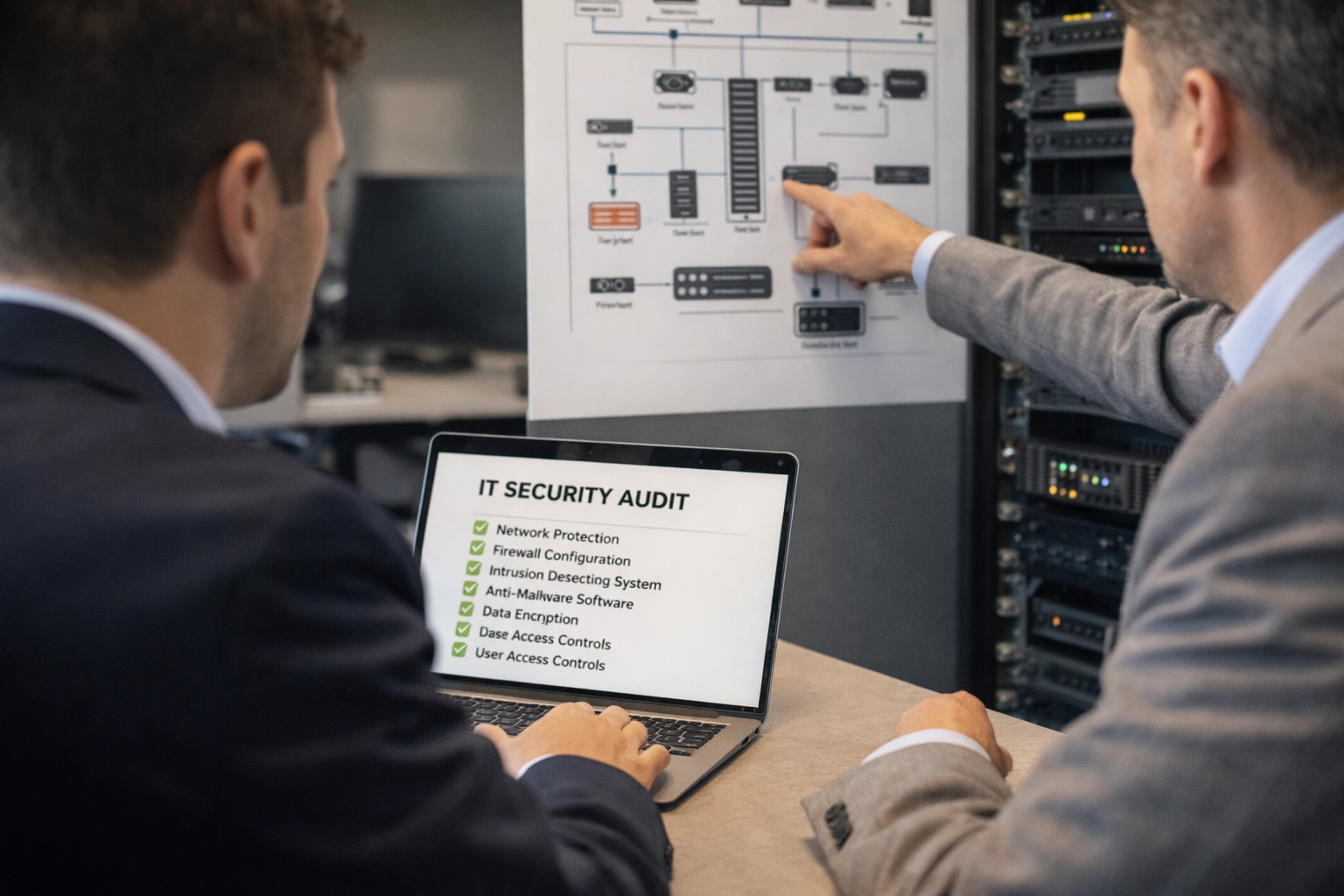
A comprehensive security audit, conducted by an independent third party, looks for the weak points that your current provider might have overlooked. These often include:
- Outdated Software: Applications that haven’t been patched in months because “they’re working fine.”
- Improper Configurations: Cloud environments like Microsoft 365 or AWS left with default settings that are easily bypassed.
- Missing Access Controls: Former employees who still have active credentials or “admin” privileges granted to people who only need “user” access.
- Credential Stuffing Risks: Employees using the same weak password for their workstation as they do for their personal Netflix account.
Without an audit, these gaps remain invisible until a threat actor finds them. By then, the cost of remediation is ten times the cost of the audit.
The Compliance Tightrope
If your business operates in a regulated industry: healthcare, finance, or law: compliance isn’t a suggestion; it’s the law. Whether it’s HIPAA, GDPR, or PCI-DSS, the regulators do not care that “your IT guy said it was fine.”
They care about documentation. They care about logging. They care about encryption.
If your provider isn’t being audited, how can you prove to a regulator that your data is secure? An independent audit confirms that your provider’s security measures align with specific legal guidelines. It ensures that when a regulator knocks on your door, you have a defensible paper trail showing that you exercised due diligence.
Reducing Financial Risks and Protecting Your Reputation
A data breach is a financial wrecking ball. Between the immediate costs of forensics, the legal fees, the potential fines, and the inevitable “ransom” demand, many small businesses never recover.
But the hidden cost is reputation. Trust takes years to build and seconds to destroy. If your clients find out their sensitive data was compromised because your IT provider didn’t have Multi-Factor Authentication (MFA) enabled on their own tools, they won’t blame the provider: they’ll blame you.
Regular IT security audits act as a form of insurance. They help you identify and mitigate risks before they manifest as a catastrophic expense. In the world of Cyber Security, an ounce of prevention is worth a pound of cure: and several million dollars in avoided losses.

Testing the Fire Drill: Incident Response Readiness
Does your IT provider have an incident response plan? If they do, when was the last time it was tested?
Most providers say they have a plan. But an audit actually tests the plan. It asks the hard questions:
- How long does it take to restore from a backup? (Have the backups been tested recently?)
- Who is the first person called at 3:00 AM on a Sunday?
- How do we communicate with clients if our primary email system is down?
Auditors review these plans and simulate scenarios to see if the provider’s team can actually detect, contain, and recover from a threat. If the “fire drill” fails during an audit, it’s a learning experience. If it fails during a real attack, it’s a funeral for your business.
Auditing Without Destroying the Relationship
A common fear among business owners is that requesting an audit will offend their current IT provider. “They’ll think I don’t trust them,” you might worry.
Think of it like a medical second opinion. A professional doctor isn’t offended when a patient seeks another perspective on a major surgery; they welcome it as part of a high-standard care plan. A professional IT provider should feel the same way.
In fact, the best providers want to be audited. It validates their hard work and identifies areas where they might need more resources or a different strategy. If your provider gets defensive or tries to block an independent audit, that is a massive red flag.
If you are struggling with internal IT gaps, you might even consider creative ways to address resource talent, but none of those strategies replace the need for an external, unbiased eyes-on-the-problem audit.

What to Look for in an Audit
Not all audits are created equal. To get the “truth” mentioned in the title of this post, you need to ensure the audit covers:
- Administrative Controls: Policies, procedures, and employee training.
- Physical Controls: Who has physical access to the servers and hardware?
- Technical Controls: Firewalls, encryption, MFA, and endpoint detection.
- Third-Party Risk: How does your provider manage their vendors?
At a PC of Mind, we believe that transparency is the foundation of security. Our leadership team focuses on providing the strategic oversight necessary to keep businesses running in an increasingly hostile digital environment.
The Final Word
Do you really need to audit your IT provider’s security?
Yes.
The goal isn’t to play “gotcha” with your current team. The goal is to verify that the safeguards you believe are in place actually exist. It’s about moving from a state of “hoping” you are secure to “knowing” you are secure.
An independent audit provides a non-biased opinion of security standards. It identifies vulnerabilities, ensures compliance, reduces financial risk, and tests your readiness for the worst-case scenario. In a world where cybercrime is a “when,” not an “if,” auditing your provider is the ultimate proactive measure.
Don’t wait for a breach to find out where the holes are. Take control of your security posture today. Your business: and your peace of mind( depends on it.)